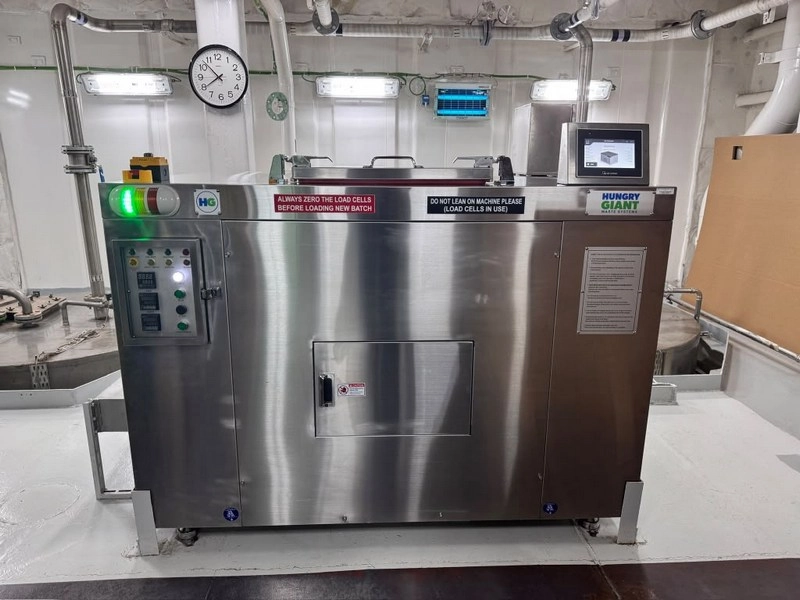
Cruise lines have long focused on how much food to buy and serve—and what happens to what remains after meals. For Chris O’Brien, founder and CEO of Austin-based Hungry Giant Waste Systems, that final question is the company’s central concern. Its food-waste processing equipment is now used by several cruise brands, with some deploying it across their fleets.
Hungry Giant offers two main systems: Chewie, a bio-grinder that macerates and dewaters food waste, and bio-dehydrators that dry it. Some ships combine the equipment to process greater volumes and reduce the amount of waste they need to store, discharge or offload.
That reduction can be especially useful on international voyages. Food waste from those trips is classified by the U.S. Department of Agriculture’s Animal and Plant Health Inspection Service as regulated garbage, which must be handled under strict rules before it leaves a ship in a U.S. port.
O’Brien’s interest in waste management began in the mid-2000s, while he was working in retail in Sydney, Australia. He noticed how much Styrofoam packaging was discarded after deliveries were unpacked and developed a machine to crush and compact it at the source. After patenting the device, he spent years building waste and recycling businesses in Australia before moving to Austin in 2018. He later turned his attention to food waste.
The company’s approach is based on a simple observation: food waste contains substantial amounts of water. Grinding it and removing the moisture can shrink its volume considerably, while leaving a stable material that is less likely to rot, smell or attract pests.
This process differs from conventional biodigesters, which use microorganisms and enzymes to break food down into a watery pulp that can be discharged at sea as liquid waste. Hungry Giant’s dehydrators instead heat the waste to temperatures that destroy pathogens, then remove moisture through a steam-and-condensation process. The result is a dry, stable biomass that can be stored and offloaded, used as a soil amendment or fertilizer, or in some cases burned for energy.
Chewie grinders are typically installed on lower decks, where they macerate food into a semi-dry pulp. A vacuum-transfer system can move waste from as many as eight kitchen stations to a central collection point—a practical arrangement for large ships with galleys spread across multiple decks. The pulp can then be sent to a dehydrator, though smaller operations may feed whole food waste directly into one.
According to O’Brien, the dehydrators reduce waste volume by about 70% to 93%. The equipment also records processing volumes and machine status through a cloud portal. Larger ships generally use several grinders and larger dehydrators, while smaller vessels can choose from more compact units.
How the resulting biomass is handled depends on the cruise line’s operations, itineraries and sustainability plans. It can be offloaded for further processing or disposed of through other approved methods.
About 90% of Hungry Giant’s cruise installations are retrofits, O’Brien said. The company manages the work itself, from surveying a ship’s available space to installing and connecting the equipment, then training the crew members who will operate it. Cruise lines do not need to hire specialized staff: existing recycling, engineering or galley teams can incorporate the equipment into their routines.
Hungry Giant is also in discussions with other major cruise brands and is pursuing opportunities aboard smaller river vessels, where reducing waste volume is a key potential benefit.
Set sail on a voyage of discovery with CruiseShip.net – your ultimate destination for all things cruising! Explore the latest news, insightful reviews, and thrilling cruising adventures from around the globe. Whether you’re a seasoned cruiser or a first-time traveler, CruiseShip.net is your go-to source for expert advice, insider tips, and inspiring stories to fuel your wanderlust. Embark on a journey like no other with CruiseShip.net – where every wave brings new excitement and endless possibilities on the high seas.
